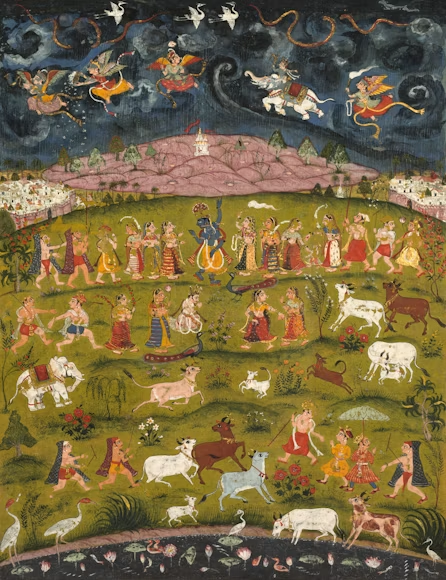
Indian Traditional Art: History and Significance
India has one of the world’s richest and most diverse artistic traditions.
From ancient cave paintings to intricate folk art and classical painting traditions, Indian art has developed over thousands of years. Different regions, communities, religions, and historical periods have contributed to this incredible artistic heritage.
Indian traditional art is not simply about beautiful colors and patterns. It often carries stories, beliefs, cultural traditions, and memories from one generation to another.
Today, traditional Indian artwork continues to inspire artists, collectors, interior designers, and homeowners around the world.
A Long History of Indian Art
The history of Indian painting can be traced back thousands of years.
Some of the earliest known examples are prehistoric rock and cave paintings. These artworks provide glimpses into the lives, activities, and environments of early communities.
Over time, Indian art developed alongside religious traditions, royal courts, local communities, festivals, and everyday life.
Paintings became a way to communicate stories and ideas.
Religious themes, mythology, nature, animals, village life, celebrations, and historical events became important subjects.
The Importance of Regional Art
One of the most fascinating aspects of Indian traditional art is its regional diversity.
Different parts of India developed their own artistic styles.
The materials, colors, subjects, techniques, and visual language often reflect the environment and culture of the region where the art originated.
This diversity makes Indian art incredibly rich.
Madhubani Painting
Madhubani painting is associated with the Mithila region of Bihar.
Traditionally, artists created paintings featuring subjects such as nature, mythology, religious themes, animals, and everyday life.
The artwork is known for strong outlines, decorative patterns, and vibrant compositions.
Madhubani art has evolved over time and is now practiced on a variety of surfaces beyond its traditional forms.
Warli Art
Warli painting comes from communities in Maharashtra.
Warli artwork is known for its simple geometric visual language.
Human figures, animals, trees, houses, farming, celebrations, and community activities are often represented through basic shapes.
Despite the simplicity of the forms, Warli paintings can communicate stories of everyday life and community.
Pattachitra
Pattachitra is a traditional painting style strongly associated with Odisha.
The word is commonly understood as referring to paintings on cloth.
Pattachitra has a long connection with religious and cultural traditions, including stories associated with Lord Jagannath and other mythological subjects.
The art is recognized for detailed compositions, decorative borders, strong outlines, and carefully developed figures.
Kalamkari
Kalamkari is a traditional Indian art form associated particularly with regions of Andhra Pradesh and Telangana.
The term is connected with the use of a pen-like tool for creating designs.
Traditional Kalamkari works may feature mythological stories, floral patterns, and decorative motifs.
The art has historically been associated with textiles as well as painted surfaces.
Gond Art
Gond art is associated with the Gond communities of central India.
Nature is an important theme in many Gond artworks.
Animals, birds, trees, plants, and stories may be represented using intricate patterns and repeated lines and dots.
Modern Gond artists continue to develop the visual language while maintaining connections to traditional storytelling.
Tanjore Painting
Tanjore painting, associated with Tamil Nadu, is known for its rich decorative appearance.
Traditional works often feature religious subjects and may use rich colors and ornamental elements.
The style is particularly recognizable for its detailed decorative qualities and dimensional embellishments.
Phad Painting
Phad is a traditional scroll-painting tradition from Rajasthan.
Historically, these paintings were used to depict stories associated with folk deities and were connected to storytelling performances.
Large compositions can contain multiple scenes, allowing a story to unfold visually.
Indian Art and Storytelling
One of the most important roles of traditional Indian art is storytelling.
Before modern forms of entertainment and mass communication, visual storytelling played an important role in communities.
Paintings could communicate stories from mythology, religious traditions, local legends, and everyday life.
This is why many traditional artworks contain multiple figures, scenes, symbols, and decorative elements.
Looking at such a painting can feel like reading a visual story.
The Role of Nature
Nature appears frequently in Indian traditional art.
Flowers, trees, birds, animals, rivers, mountains, and other natural elements are commonly represented.
Nature may be used purely for decoration, but it can also have symbolic or cultural significance.
The relationship between people and nature is an important theme across many Indian artistic traditions.
Traditional Art in Modern Homes
Today, Indian traditional artwork can fit beautifully into modern interiors.
A traditional painting can provide warmth and cultural character to a contemporary room.
For example, a colorful traditional artwork can become a focal point in a minimalist living room.
A smaller painting can add character to a hallway, study, or bedroom.
Traditional artwork can also be combined with modern furniture to create an interesting contrast between old and new.
Why Traditional Indian Art Still Matters
Traditional art is not simply something from the past.
Artists continue to reinterpret traditional styles and introduce them to new audiences.
By purchasing and displaying traditional artwork, people can support artists and help maintain interest in cultural craftsmanship.
Art also provides a way for cultural knowledge to travel across generations.
A child seeing a traditional painting at home may become curious about its story, region, characters, or artistic technique.
In this way, artwork can become an entry point into cultural education.
Choosing Traditional Indian Artwork
If you are interested in purchasing traditional Indian art, take time to learn about the style and its origins.
Ask questions about:
- The artistic tradition
- The region associated with it
- The subject of the painting
- Materials used
- Technique
- Artist background
- Care requirements
Understanding the story behind an artwork can make owning it even more meaningful.
Final Thoughts
Indian traditional art represents centuries of creativity, storytelling, culture, and craftsmanship.
From Madhubani and Warli to Pattachitra, Kalamkari, Gond, Tanjore, and many other traditions, India’s artistic heritage is remarkably diverse.
These art forms continue to evolve while remaining connected to their cultural roots.
A traditional Indian painting can therefore be much more than a decorative object. It can be a piece of cultural storytelling, a celebration of craftsmanship, and a connection between the past and the present.
By appreciating, collecting, and sharing traditional Indian art, we help ensure that these artistic traditions continue to inspire future generations.